2025年第52卷第10期目录
| |
|
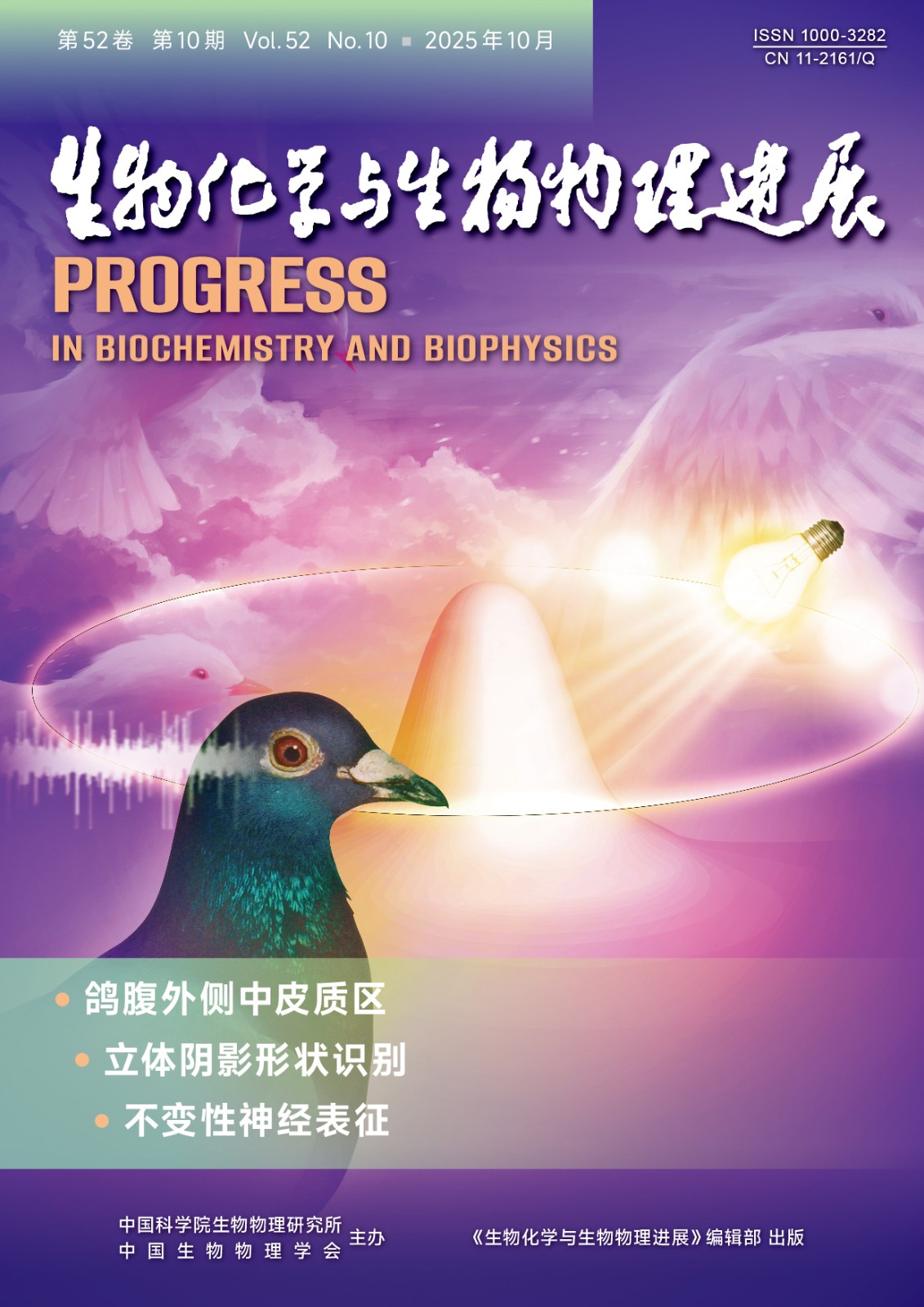
封面故事:该论文以鸽子为研究对象,探讨了腹外侧中皮质(MVL) 神经元在立体阴影形状识别
中的不变性神经表征。研究设计了不同光照角度条件下凸起与凹陷两类立体刺激,采用行为学实
验与电生理记录相结合的方法,分析了鸽子在立体形状识别任务中的表现以及MVL神经元的响应
模式。统计结果表明,训练鸽子识别出凹凸两类立体阴影形状后,在改变形状的光照角度等条件
下行为学分类表现依然保持稳定。同时,MVL神经元在对凹凸两类形状的响应也展现出稳定的选
择性和一定程度的不变性,能够在外部条件改变时维持对立体形状较为稳定的编码模式。该研究
不仅为理解非哺乳动物视觉系统中立体视觉信息处理提供了新的实验证据,也为探索神经元不变
性编码的机制奠定了理论基础。
(牛晓可,张梦博,彭岩岩,韩永浩,王庆玉,邓宜鑫,李志辉. 鸽腹外侧中皮质神经元对立体阴影形状的
不变性神经表征, 本期第2614~2626 页)
Cover Story:Objective In nature, objects cast shadows due to illumination, forming the basis for stereoscopic perception. Birds need to adapt to changes in lighting (meaning they can recognize stereoscopic shapes even when shadows look different) to accurately perceive different three-dimensional forms. However, how neurons in the key visual brain area in birds handle these lighting changes remains largely unreported. In this study, pigeons (Columba livia) were used as subjects to investigate how neurons in pigeon’s ventrolateral mesopallium (MVL) represent stereoscopic shapes consistently, regardless of changes in lighting.Methods Visual cognitive training combined with neuronal recording was employed. Pigeons were first trained to discriminate different stereoscopic shapes (concave/convex). We then tested whether and how light luminance angle and surface appearance of the stereoscopic shapes affect their recognition accuracy, and further verify whether the results rely on specify luminance color. Simultaneously, neuronal firing activity of neurons was recorded with multiple electrode array implanted from the MVL during the presentation of difference shapes. The response was finally analyzed how selectively they responded to different stereoscopic shapes and whether their selectivity was affected by the changes of luminance condition (like lighting angle) or surface look. Support vector machine (SVM) models were trained on neuronal population responses recorded under one condition (light luminance angle of 45°) and used to decode responses under other conditions (light luminance angle of 135°, 225°, 315°) to verify the invariance of responses to different luminance conditions.Results Behavioral results from 6 pigeons consistently showed that the pigeons could reliably identify the core 3D shape (over 80% accuracy), and this ability wasn’t affected by changes in light angle or surface appearance. Statistical analysis of 88 recorded neurons from 6 pigeons revealed that 83% (73/88) showed strong selectivity for specific 3D shapes (selectivity index>0.3), and responses to convex shapes were consistently stronger than to concave shapes. These shape-selective responses remained stable across changes in light angle and surface appearance. Neural patterns were consistent under both blue and orange lighting. The decoding accuracy achieves above 70%, suggesting stable responses under different conditions (e.g., different lighting angles or surface appearance).Conclusion Neurons in the pigeon MVL maintain a consistent neural encoding pattern for different stereoscopic shapes, unaffected by illumination or surface appearance. This ensures stable object recognition by pigeons in changing visual environments. Our findings provide new physiological evidence for understanding how birds achieve stable perception (“invariant neural representations”) while coping with variations in the visual field.
|
本期特稿
综述与专论
研究报告
技术与方法
科教融合
|
|
