2026年第53卷第7期目录
| |
|
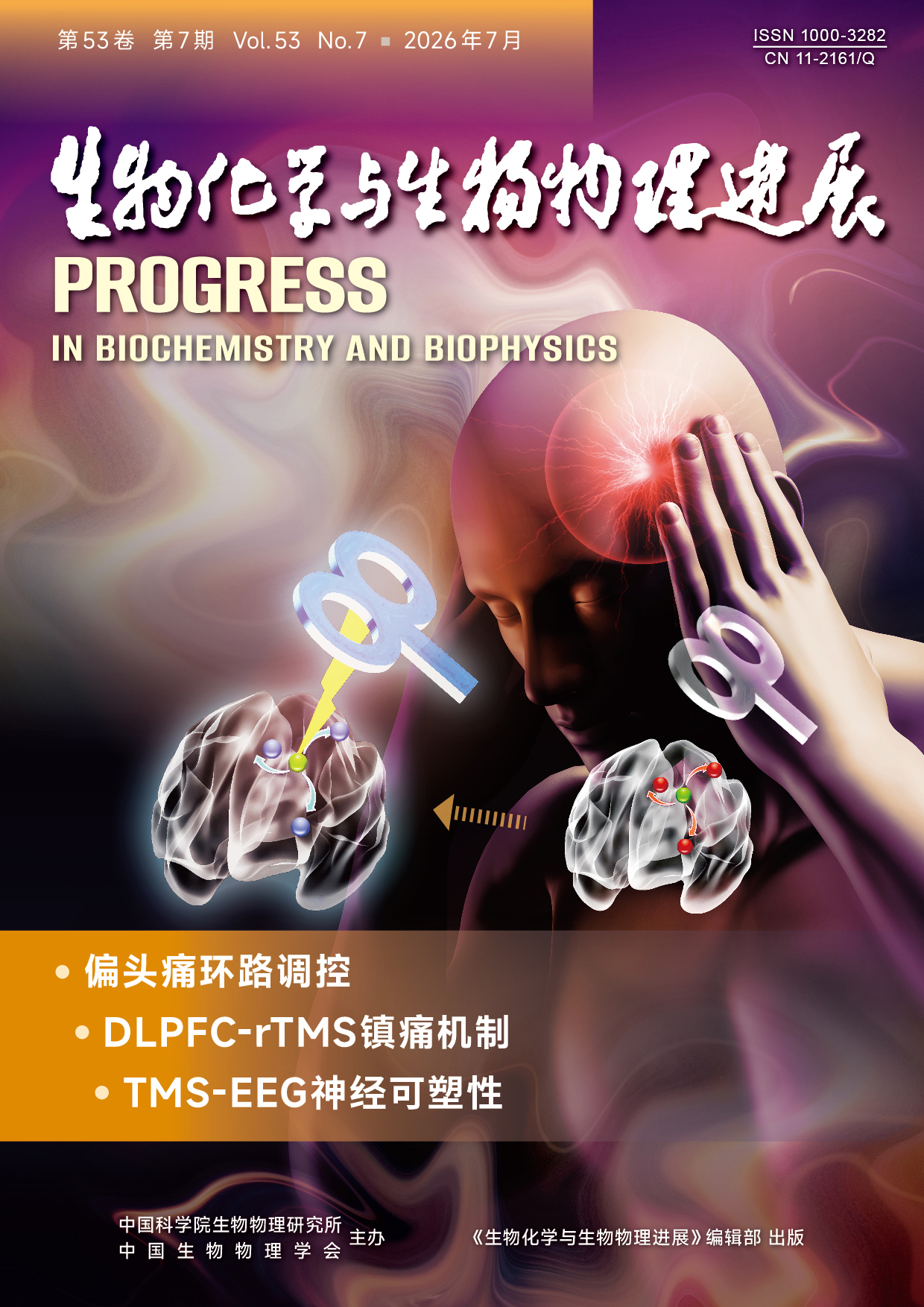
封面故事:偏头痛影响着全球近1.16亿人,其反复发作的剧烈疼痛严重降低了患者的生活质量。重
复经颅磁刺激技术(rTMS) 作为一种非侵入性疗法,虽展现出治疗前景,但其背后的神经机制长
期悬而未决。该研究采用同步经颅磁刺激与脑电图技术(TMS-EEG),以精准捕捉背外侧前额叶皮
层(DLPFC) 在刺激后毫秒级的神经活动变化,从而揭示DLPFC-rTMS的镇痛机制。该研究发现,
偏头痛患者不仅存在局部皮层去抑制,表现为N120波幅异常,更在疼痛处理的关键脑区,包括负
责感知辨别的初级躯体感觉皮层(S1),以及负责情感认知评估的前脑岛(aINS) 和中扣带回
(MCC),呈现出异常升高的显著电流密度(SCD)。此外,单次DLPFC-rTMS干预选择性地降低了
aINS、MCC及S1的过度活跃。更重要的是,MCC和S1的SCD降低程度直接与参与者疼痛耐受能力
的提升显著相关。该发现不仅从神经环路层面揭示了rTMS的镇痛原理,更为优化偏头痛及慢性疼
痛的个体化治疗方案提供了新的生物标志物与干预靶点。
(金晨霞,谭柏林,叶扬,何吉庆,王凌燕,高忠明,王宇俊,刘慧丽,严永兴,车先伟. 背外侧前额叶皮层
重复经颅磁刺激治疗偏头痛的神经环路特征, 本期第1953~1968 页)
Cover Story:Objective Migraine is a leading neurological disorder and the fourth most common cause of years lived with disability worldwide, affecting nearly 116 million individuals. Although pharmacological treatments are available, their efficacy is often limited by side effects and variable response rates. Repetitive transcranial magnetic stimulation (rTMS) over the dorsolateral prefrontal cortex (DLPFC) offers a safe, non-invasive alternative for migraine management. However, the neurophysiological mechanisms, particularly how rTMS modulates local cortical excitability and distributed pain-related circuits, remain poorly understood. Elucidating these mechanisms is essential for optimizing treatment protocols and improving clinical outcomes.Methods This study employed concurrent transcranial magnetic stimulation and electroencephalography (TMS-EEG) to investigate neuroplastic and neurocircuitry mechanisms of DLPFC-rTMS in migraine. Study 1 compared 30 migraineurs and 28 healthy controls to identify abnormalities in TMS-evoked potentials (TEPs) and significant current density (SCD) within sensory-discriminative regions including the primary somatosensory cortex (S1) and posterior insula (pINS), cognitive-affective regions including the anterior insula (aINS) and midcingulate cortex (MCC), and a descending modulatory region, the periaqueductal gray (PAG). Study 2 used a single-blind, crossover, sham-controlled design in 34 healthy participants. Each participant received both active (10 Hz, 80% RMT, 1 500 pulses) and sham DLPFC-rTMS in counterbalanced order. TMS-EEG and cold pain tolerance were assessed before and after each session.Results In Study 1, migraineurs showed a significantly less negative N120 amplitude compared to healthy controls (P=0.027, Cohen’s d=0.60), indicating local intracortical disinhibition. No group differences were observed for N40, P60, or P180 components. At the source level, migraineurs exhibited significantly higher SCD in the S1, pINS, aINS, and MCC (all Q<0.05), but not in the ventroposterior thalamus (vpTHAL), mediodorsal thalamus (mdTHAL), or PAG. In Study 2, active rTMS significantly reduced SCD from pre- to post-stimulation in the S1, aINS, and MCC (all Q<0.05). Sham stimulation also reduced SCD in the S1 (Q<0.05) but not in the aINS or MCC. Although no significant group-level analgesic effect was observed between active and sham conditions (P=0.107), correlation analyses revealed that greater SCD reductions in the S1 and MCC were significantly associated with higher post-rTMS pain tolerance (R=-0.487 and -0.495, both Q<0.01) and larger improvements in pain tolerance (R=-0.487 and -0.451, both Q<0.05). No such correlations were found following sham stimulation, suggesting that the behavioural relevance of neural changes is specific to active rTMS.Conclusion This study provides novel evidence that migraineurs exhibit both local neuroplastic abnormalities (reduced N120 amplitude) and hyperactivity in key pain-processing regions (S1, pINS, aINS, MCC). A single session of DLPFC-rTMS reduced hyperactivity in the aINS, MCC, and S1. Notably, greater reductions in the S1 and MCC were associated with improved pain tolerance. These findings identify distinct cortical circuitries, particularly within the cognitive-affective pain network, that may serve as potential biomarkers for optimizing rTMS treatment in migraine and other chronic pain conditions. Future studies should validate these results in patient populations experiencing spontaneous migraine attacks and explore multi-session or accelerated rTMS protocols.
|
综述与专论
研究报告
技术与方法
动态与评论
|
|
