2025年第52卷第9期目录
| |
|
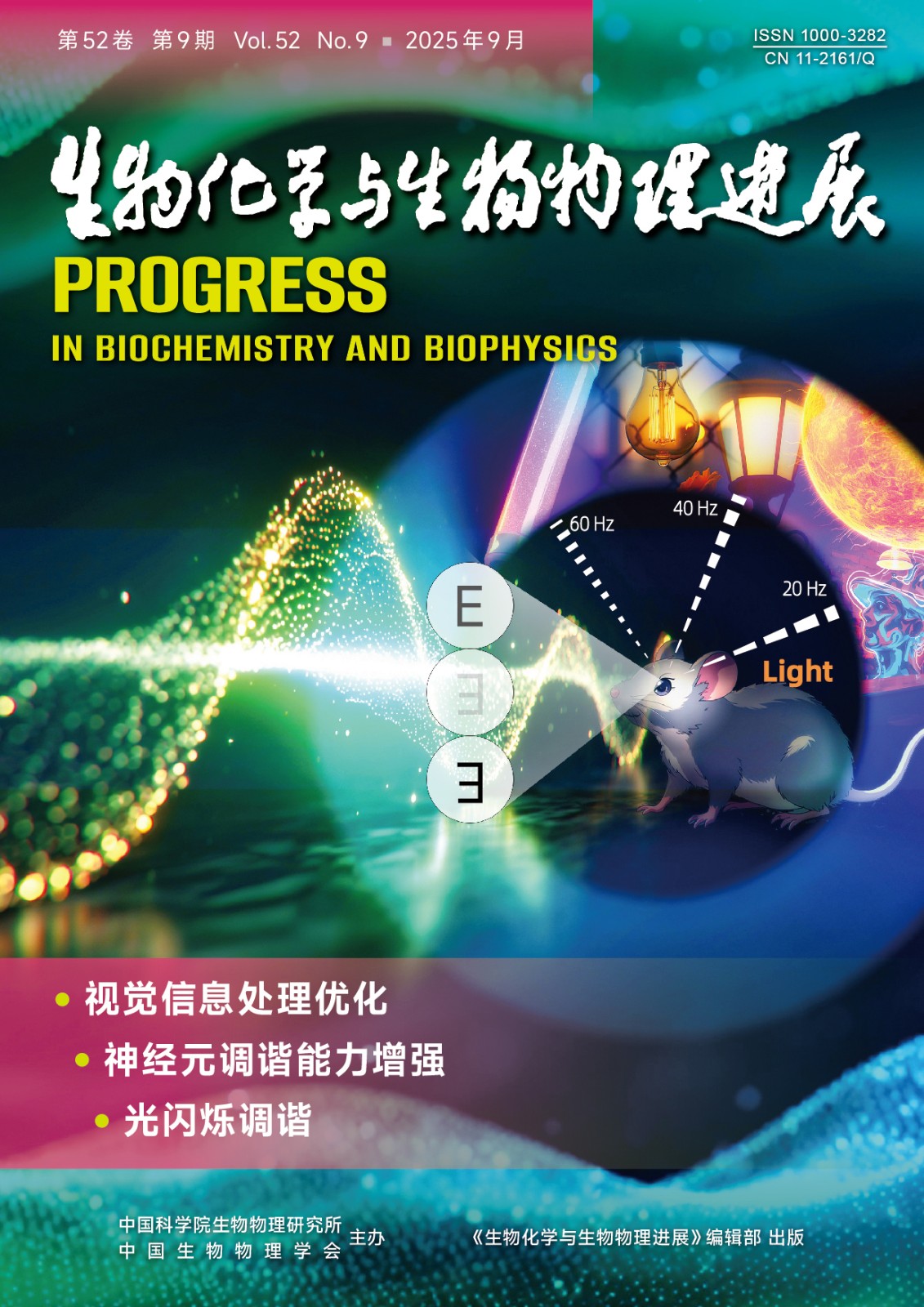
封面故事:视觉系统如何在复杂多变的光环境中保持高效、精准的信息处理?自然界与人造光源
中普遍存在的光闪烁现象,为我们揭示大脑功能的动态调控机制提供了独特的窗口。该研究探究
了不同频率(20、40、60 Hz) 的非侵入性光刺激对小鼠初级视觉皮层(V1) 的影响。通过在体电
生理记录发现,长期闪烁刺激能显著增强V1神经元的方位调谐能力,而40 Hz和60 Hz的高频刺激
还能提升对比敏感度。这些功能优化的背后,是神经信息处理效率的根本性提升:神经元反应变
异性与噪音相关性降低,信噪比则显著上升。闪烁光通过“净化”神经信号,使视觉编码更为精
确和可靠。
(李雪琪,周逸峰,徐光威. 非侵入性光闪烁刺激对成年小鼠初级视觉皮层功能特性的影响, 本期第
2360~2375 页)
Cover Story:Objective As the central hub of the classical visual pathway, the primary visual cortex not only encodes and processes visual information but also establishes dense neural circuit connections with higher-order cognitive brain regions. Numerous studies have shown that 40 Hz flicker stimulation can induce γ oscillations in the brain and significantly improve learning and cognitive impairments in patients with neurodegenerative diseases. Moreover, flickering light phenomena naturally occur in daily environments. Given that the primary visual cortex serves as the brain’s first cortical hub for receiving visual input, it is essential to comprehensively understand how non-invasive light flicker stimulation modulates its information processing mechanisms. This study systematically investigates the effects of non-invasive light flicker stimulation at different frequencies on the functional properties of neurons in the primary visual cortex of adult mice, aiming to uncover how such stimulation modulates this region and, consequently, affects overall brain function.Methods Three groups of adult mice (approximately 12 weeks old) were exposed to light flicker stimulation at frequencies of 20 Hz, 40 Hz, and 60 Hz, respectively, for a duration of two months. A control group was exposed to the same light intensity without flickering. Following the stimulation period, in vivo multi-channel electrophysiological recordings were conducted. During these recordings, anesthetized mice were presented with various types of moving sinusoidal light gratings to assess the effects of different flicker frequencies on the functional properties of neurons in the primary visual cortex.Results The experimental results demonstrate that two months of light flicker stimulation at 20 Hz, 40 Hz, and 60 Hz enhances the orientation tuning capabilities of neurons in the primary visual cortex. Specifically, 40 Hz and 60 Hz stimulation improved contrast sensitivity, whereas 20 Hz had no significant effect. Further analysis revealed that all three frequencies reduced neuronal response variability (as measured by the Fano factor), increased the signal-to-noise ratio, and decreased noise correlation (rsc) between neurons.Conclusion Non-invasive light flicker stimulation enhances orientation tuning (e.g., orientation bias index) and contrast sensitivity (e.g., contrast threshold and C50) in neurons of the primary visual cortex. This enhancement is likely due to improved information processing efficiency, characterized by reduced neuronal variability and increased signal-to-noise ratio. These findings suggest that the primary visual cortex can achieve precise and efficient information encoding in complex lighting environments by selectively adapting to different flicker frequencies and optimizing receptive field properties. This study provides new experimental evidence on how various types of light flicker influence visual perception and offers insights into the mechanisms through which specific frequencies enhance brain function.
|
综述与专论
研究报告
技术与方法
|
|
